





1. Selection direction: Frost resistance, large-fruited, disease resistance, seedlessness.
2.Specifications: Brief description of the parent couple. Description.
Таlisman. Large fruit, disease resistance.
Seedless black winter-hardy. Frost resistance, seedless.
3.Implementation:
Hybridization was carried out in 2010 during the flowering of grapes. Forced pollination of the maternal variety Talisman with pollen from the paternal variety Kishmish black winter-hardy. Pollination was carried out twice a day (morning and evening) for 7-10 days until the berries were completely set. Inflorescence isolation was not applied.
A total of 256 hybrid seeds were obtained. When checking the viability "on the water" 150 seeds remained. After stratification in the winter and germination in January 2011, 60 seedlings were planted in cups. Seed germination of this hybrid combination is medium-high. During the hardening of seedlings on the street in the spring, an initial selection was made for resistance to mildew.
Planting seedlings in the ground was carried out in May-June 2011 - 42 pieces. The following year, 18 more pieces were planted from the same seeds. A total of 60 seedlings were planted on the site. Seedlings of this hybrid combination are mostly vigorous, have good resistance to fungal diseases and frost. For the winter, seedlings do not hide from birth.
The first and rather amicable fruiting of hybrid forms was in 2013. Many forms from this combination had a signal size of berries from 6 to 10 grams and bunches of 300 - 500 grams. Later, with the age of the seedlings, the dimensional characteristics of berries and clusters increased by a lot..
Most of the seedlings have a pleasant harmonious taste, dense crispy flesh. Muscovites are not. Seeds are medium or large. Crack resistance is very high. Resistance to fungal diseases is increased, at the level of 2.5-3 points on the susceptibility scale.
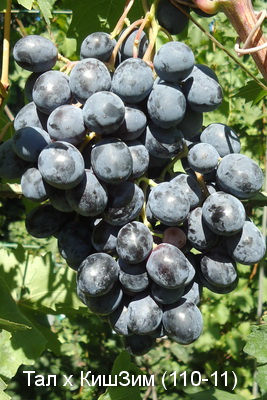
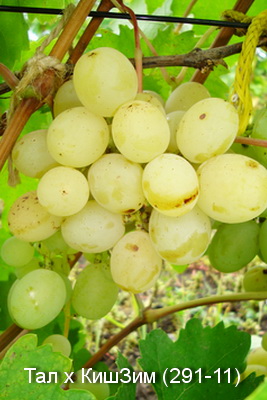
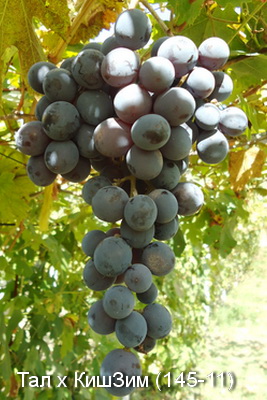
Hybrid offspring from this combination are very diverse: in size, color and shape of the berry, in terms of ripening and yield. Berries are white or dark. There are no reds or pinks. Unfortunately, there were very, very few seedlings of raisins, only a few pieces.
This is not the main thing for me in selection, but still I would like more. Worthy for selection, in my opinion and observations for five years, was not.
The first main selection of seedlings was made after the third fruiting in 2015. From the selected seedlings, a vine was cut for the production of grafts on old powerful bushes to test hybrid forms in the load.
Also, cut cuttings were used to test frost resistance in the laboratory by pre-hardening and freezing in a freezer.
The results of freezing cuttings can be found in the section: "frost resistance test". Мresistance of hybrid forms in this combination is within - 27, - 28 gr.s.
One of the most successful combinations in my selection.
4. Advantages: Reat vigor, good maturation of the vine, large fruit and yield, disease resistance, frost resistance. Many forms lie well in storage after maturation.
5.Flaws: There are few seedlings of early ripening, many forms with FZHTC.
6. Primary selection: In this hybrid combination, I selected the following hybrid seedlings as elite for further study and testing in different climatic zones: Evgeniya (296-11) and Carbonado (110-11).
7.Рerspective He combination turned out to be promising for breeding for frost resistance of table grapes. For testing at the NSC "Institute of Viticulture and Winemaking named after A. V.E. Tairov” 3 hybrid forms were transferred: Tal x KishZim (296-11), Tal x KishZim (110-11), Tal x KishZim (291-11),
(Description compiled in 2017)
The Carbonado grape variety has been included in the Register of Plant Varieties Suitable for Distribution in Ukraine since 16.12.2021. Copyright certificate N 211093, patent N 211064.


